
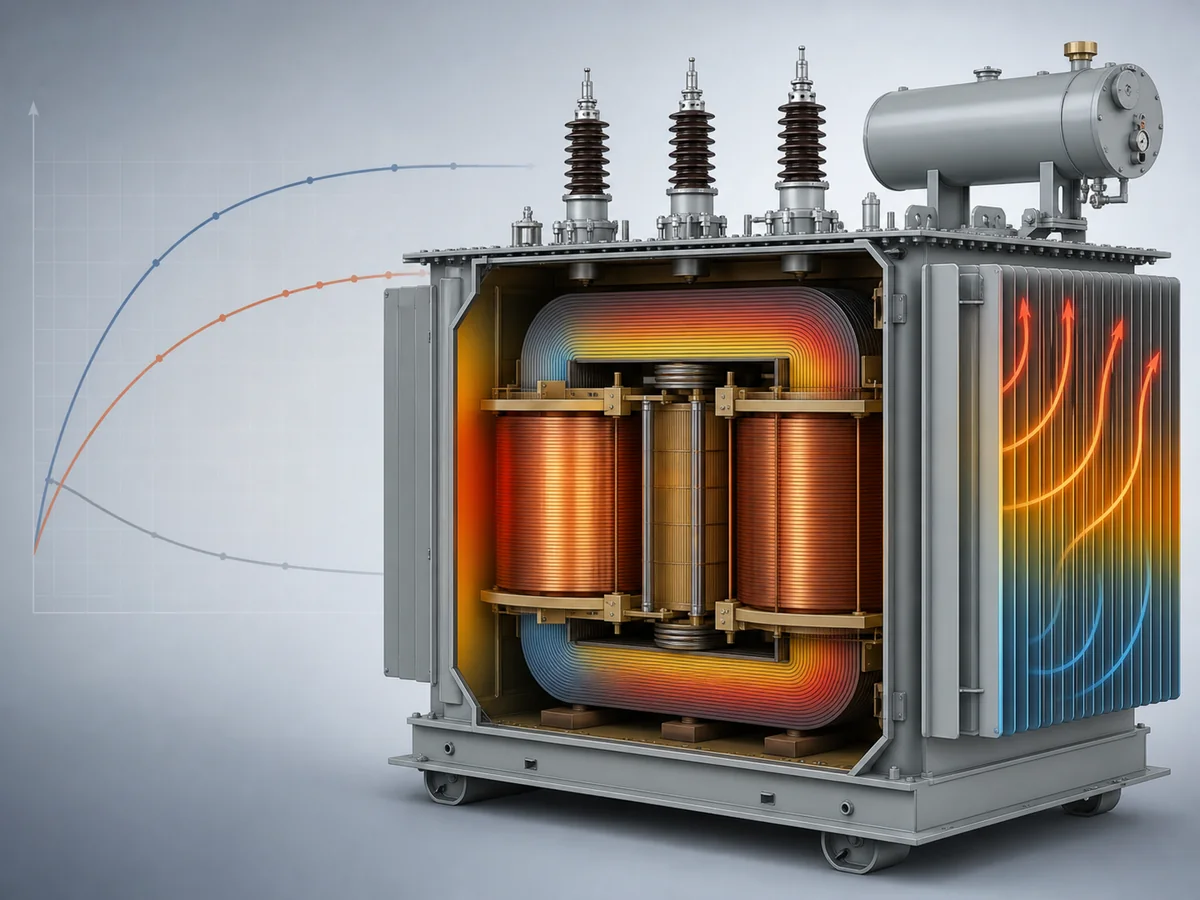
A transformer may remain energised for decades, so a small difference in loss can become a large difference in lifetime energy cost. The comparison must still be technically fair: no-load loss and load loss arise differently, respond to different operating conditions and are reported at defined reference conditions.
The two loss figures every comparison should separate
No-load loss
No-load loss is present whenever rated voltage and frequency energise the transformer, even when the secondary supplies almost no load. It mainly includes hysteresis and eddy-current loss in the core.
- Strongly influenced by core material and flux density.
- Approximately continuous for an energised transformer.
- Important for lightly loaded or continuously energised units.
Load loss
Load loss is measured with current flowing and includes winding resistance loss plus stray losses caused by leakage flux in windings, tank and structural parts.
- Winding loss changes approximately with current squared.
- Resistance changes with winding temperature.
- Important for heavily loaded and high-utilisation units.
Why load loss is corrected to a reference temperature
Copper or aluminium winding resistance increases as temperature rises. A test performed on a cool transformer cannot be compared directly with a guarantee stated at a different temperature. Applicable standards define how measured resistance and load loss are corrected to the specified reference temperature. The bid, guarantee and final test report should all use the same basis.
Efficiency depends on the actual load point
Total loss at a particular operating point combines no-load loss with the current-dependent load loss at that point. Auxiliary power for fans or pumps should be included when the agreed evaluation requires it.
If load current is 50% of rated current, the winding-resistance component is approximately 25% of its rated-current value. No-load loss, however, remains present while the transformer is energised. This is why the “best” design may differ between a lightly loaded distribution transformer and a generator step-up transformer operating near rated output.
Do not compare one efficiency percentage in isolation
| Check | Reason |
|---|---|
| Rated kVA or MVA and load factor | The loss balance changes with loading. |
| Power factor used for efficiency | Output power in kW depends on power factor. |
| Reference temperature | It changes the corrected winding-loss component. |
| Cooling stage and auxiliary power | Fans and pumps consume energy and may define a higher rating stage. |
| Voltage and frequency basis | Core loss depends on the energising condition. |
| Tolerances and capitalisation formula | The purchaser may assign a financial value to each guaranteed watt. |
Other losses that may matter
Stray loss is produced when leakage magnetic fields induce current in conductors and metallic structural parts. Dielectric loss occurs in the insulation system and is normally a smaller part of total power loss, though dielectric condition remains important. Harmonic load current can increase winding and stray losses; rectifier, data-centre and inverter duties therefore need load-spectrum information rather than a generic “nonlinear load” label.
Losses become heat that the cooling system must remove
The temperature-rise design connects electrical loss to insulation life and usable capacity. Oil-immersed transformers may use natural or forced oil and air circulation. Dry-type transformers commonly use natural air or forced-air stages. A higher fan-assisted rating is only available when the agreed fans, controls, airflow and ambient conditions are present.
A practical bid-evaluation method
- Define the duty cycle.Estimate annual energised hours and the expected loading profile.
- Request separate guarantees.List no-load loss, load loss, auxiliary power and the relevant reference conditions.
- Use one evaluation basis.Apply the same energy price, present-value period and loss-capitalisation method to every bid.
- Check test tolerances.State how guaranteed and measured losses will be assessed under the governing standard and contract.
- Review the thermal design.Confirm temperature rise, cooling stages and site ambient conditions alongside efficiency.
Key takeaway
No-load loss is the cost of keeping the transformer energised; load loss grows with current and temperature. An effective comparison uses separate guaranteed values, a common reference basis and the project’s real operating profile. The lowest purchase price and the lowest lifetime cost are not always the same transformer.
Compare this guidance with the oil-immersed distribution transformer range and the transformer impedance selection guide.