
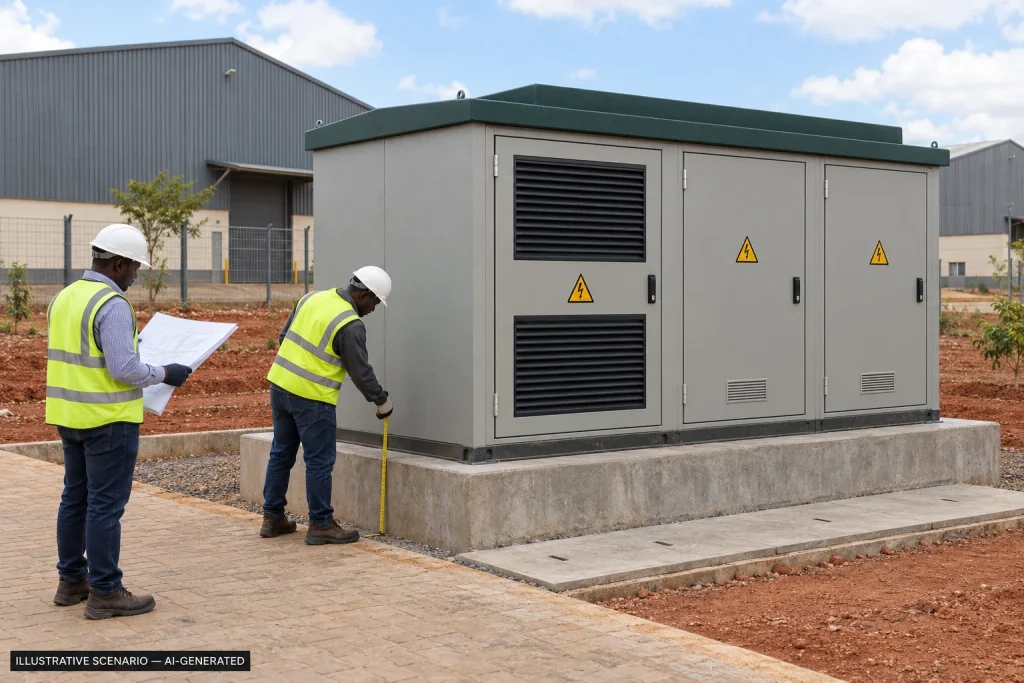
Buying a compact substation in Kenya starts with the approved connection conditions, not an enclosure photograph. The transformer, medium-voltage equipment, low-voltage board, enclosure and civil works need to form one coordinated system. This scenario follows an industrial buyer from the first quotation request to the documents needed before energization.
The scenario: a Kenyan industrial facility planning a new supply
Assume a private industrial facility needs power for production equipment, a warehouse and auxiliary services. The buyer is considering an outdoor packaged substation with an oil-immersed transformer, MV switching and protection, and an LV distribution board. In this example, an 11/0.415 kV, 50 Hz, 630 kVA arrangement is a starting point for engineering review, not a universal Kenyan specification or a confirmed Apex order.
Kenya’s distribution grid operates around a nominal frequency of 50 Hz. The actual connection voltage, permitted capacity, metering location and protection interface must come from the connection provider. An 11 kV example must not be substituted for a site offered a 33 kV connection. Likewise, the nameplate LV voltage must match the approved supply and the facility’s equipment.
| Illustrative planning item | Working assumption | What the buyer must confirm |
|---|---|---|
| Facility demand | 450 kW at 0.90 power factor | Maximum demand, motor starting, harmonics and operating profile |
| Transformer capacity | 630 kVA candidate | Actual load study, growth allowance and enclosure/site derating |
| Voltage and frequency | 11/0.415 kV, three-phase, 50 Hz | Connection offer, LV equipment ratings, ratio and tapping requirements |
| MV arrangement | Radial or ring connection to be agreed | Utility interface, metering, fault duty and fuse/relay coordination |
| Location | Inland industrial site | Altitude, ambient profile, drainage, access and pollution conditions |
1. Convert the load list into a realistic purchasing brief
The simplified apparent-power calculation is 450 kW / 0.90 = 500 kVA. Adding an illustrative 20% planning allowance gives 600 kVA, which makes 630 kVA a candidate for review. This arithmetic alone does not select the transformer: large motor starts, non-linear loads, simultaneous operation, future expansion and enclosure temperature can change the result.
At 630 kVA and 415 V, the balanced three-phase full-load current is approximately 876 A. The LV assembly, incomer, cables and terminations must be selected with their actual installation conditions, fault duty and temperature limits. A catalogue current rating is not proof that the complete board will carry the required load inside the chosen enclosure.
Give each supplier the same load schedule, single-line diagram and connection conditions. Compare guaranteed losses, impedance, noise, accessories and test scope as well as the purchase price. For the input data, use our transformer RFQ checklist.
2. Specify the Kenyan site, not a generic Africa package
A coastal location and a highland industrial site should not receive an identical environmental schedule by default. For the actual site, state altitude, ambient-temperature limits, solar exposure, airborne dust, humidity, corrosion risk and the drainage assessment. Coastal salt exposure may require a different coating system and maintenance plan; an elevated inland site may require manufacturer evaluation of cooling and external insulation.
Specify ventilation without allowing rain, pests or dust control to compromise heat rejection. Do not choose an enclosure IP rating in isolation. Agree door access, maintenance space, equipment replacement routes, locks, warning labels and segregation. The compact substation layout guide explains why these interfaces should be frozen before manufacturing.
3. Agree the equipment package and the approval boundary
A compact substation is more than a transformer placed in a box. The enquiry should cover the MV switching/protection function, transformer, LV assembly, internal connections, enclosure, earthing interfaces and the evidence for the assembled arrangement. IEC 62271-202 addresses enclosed prefabricated substations within its scope; IEC 60076 applies to relevant transformer requirements, while the selected switchgear and LV assembly need their own applicable standards.
For the MV side, confirm whether the network is radial or ring-fed, who supplies the metering and where the ownership boundary lies. Choose rated voltage and insulation, short-circuit duty, interlocks and protection from the approved design. IEC-based design is not the same as Kenya Power acceptance. Ask the connection provider which drawings, equipment qualifications and inspections are needed before placing the order.
4. Freeze civil works and delivery interfaces before dispatch
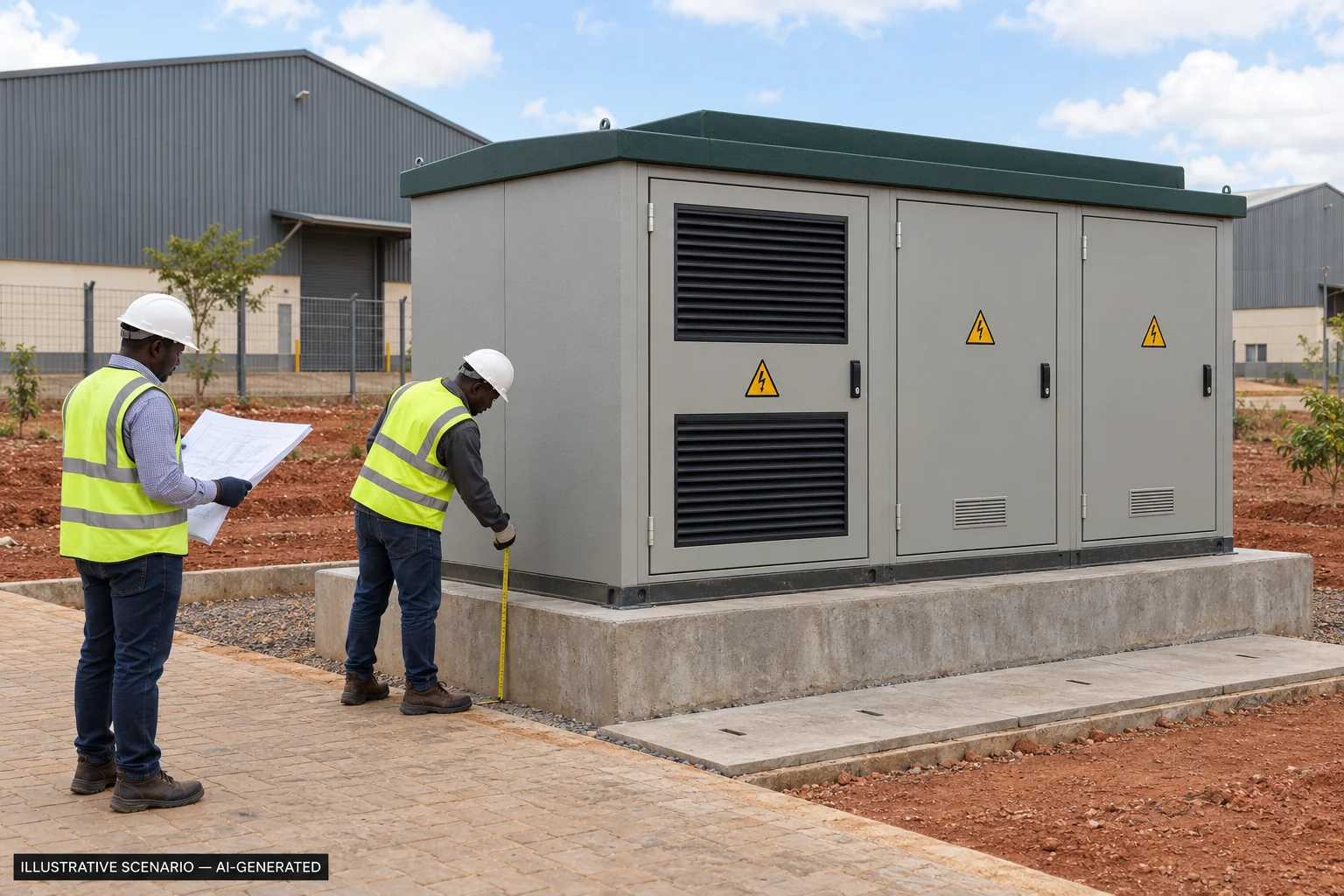
- Foundation: use the manufacturer’s approved general arrangement, mass, support points, anchor details and cable openings. The civil engineer determines soil capacity, drainage and the final structure.
- Delivery route: agree the arrival point, inland route, vehicle access, turning room, lifting equipment and responsibility for unloading. State the named location and applicable Incoterms rule in the contract.
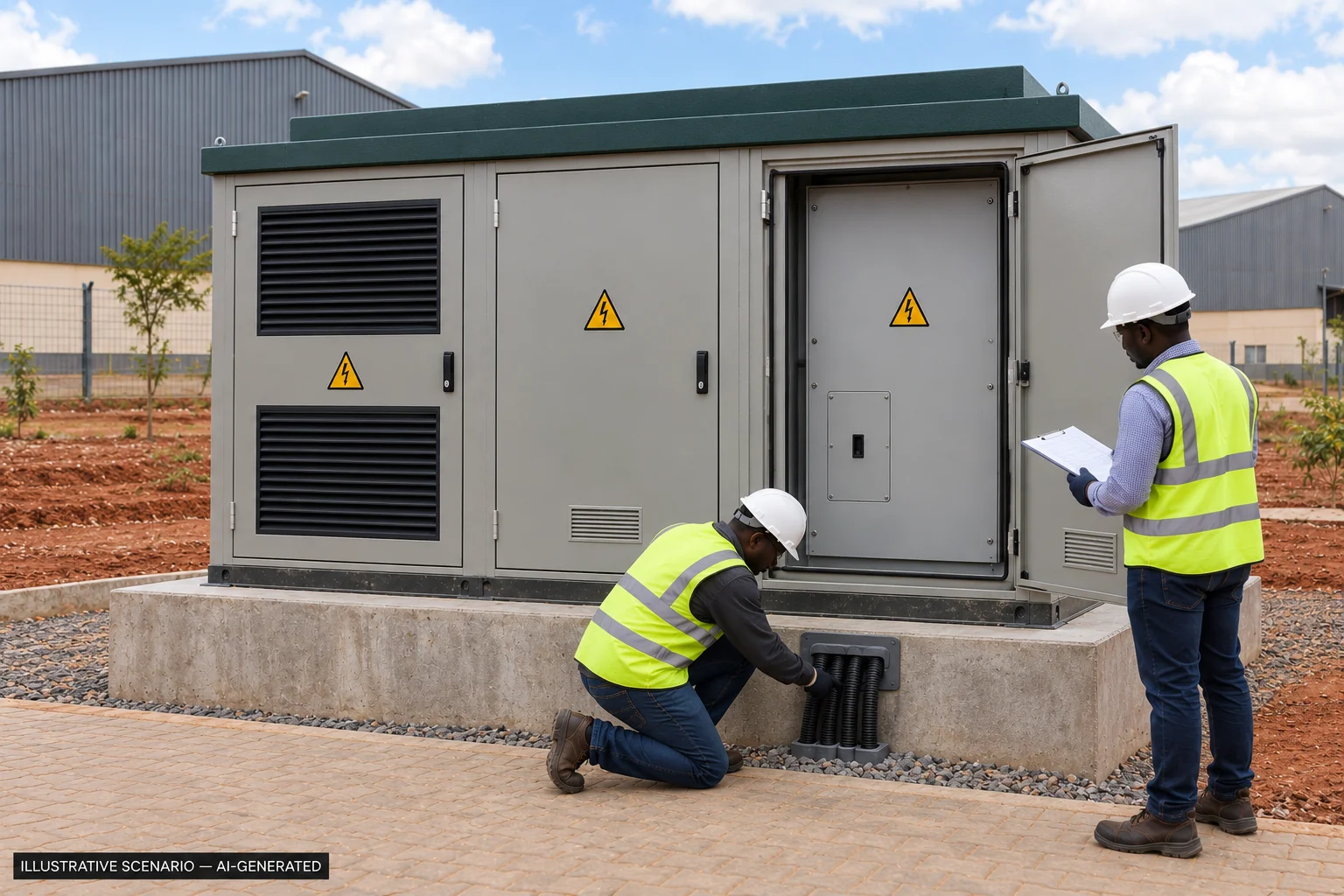
- Cable entry: coordinate bend radii, termination space, trench water management, fire/pest sealing and separation between MV, LV and control cables.
- Earthing: design the system from the network arrangement, fault level, clearing time and soil conditions. Do not copy an arbitrary earth-resistance number from another project.
- Import documents: the importer should confirm the current KEBS conformity route, any applicable exemptions and shipment documents before loading. A generic IEC test report does not by itself settle Kenya’s import formalities.
5. Treat installation as a controlled sequence
The following is a buyer’s coordination checklist, not a field-work instruction. Electrical work and energization must be planned and performed by appropriately licensed and authorized personnel using the approved design, manufacturer instructions and local requirements.
- Receive and inspect: reconcile equipment identification, packing list and transport condition; record damage, leaks or missing items before installation proceeds.
- Release the foundation: check dimensions, level, drainage, supports, access and cable openings against the approved drawings.
- Position and secure: use a documented lifting/positioning plan and only manufacturer-designated lifting points; protect personnel and equipment with a controlled exclusion zone.
- Complete interfaces while isolated: qualified personnel complete earthing, cable termination, sealing and connections under the agreed safety procedures.
- Close the inspection record: check identification, labels, mechanical interlocks, access and documentation before requesting commissioning release.
6. Define the evidence needed before energization
The factory documentation should identify the exact supplied equipment and the agreed routine tests. Where type-test evidence is required, check that it is applicable to the proposed design rather than accepting an unrelated certificate. See routine, type and special transformer tests for the distinctions.
The site commissioning plan should address, as applicable, transformer ratio/vector group and insulation checks, cable and earthing verification, approved protection settings, interlock operation, metering, phase sequence and functional checks. Test voltages, methods and acceptance criteria must be equipment-specific. Sensitive electronics and surge-protection devices may need isolation or special treatment during testing.
The asset owner and connection provider determine the authorization to energize. Retain signed test sheets, approved settings, as-built drawings, operating instructions and the responsible contacts. This scenario does not claim that any of these steps have been completed at a real site.
Questions Kenyan compact-substation buyers often ask
Can I specify 33 kV instead of 11 kV?
Only when it matches the approved connection and design. Changing the primary voltage affects the transformer, MV equipment, insulation coordination, cable interfaces and approvals. It is not just a nameplate change.
Is a 630 kVA unit suitable for every small factory?
No. The capacity in this scenario is illustrative. Selection depends on measured or calculated demand, power factor, motor starting, harmonics, expansion and site/enclosure conditions.
Does a compact substation remove the need for civil works?
No. The buyer still needs a suitable foundation, drainage, access, cable routes and earthing, designed for the actual site and equipment.
Is this a real Kenyan Apex delivery case?
No. It is an educational procurement and installation scenario. The configuration and people are illustrative, and all scene images are AI-generated. Actual project references should be requested separately and verified before use.
Request a Kenya-specific compact-substation review
Send the town/site location, connection voltage, required kVA or load list, LV voltage, quantity and single-line diagram. If some ratings are not yet known, send the connection offer or describe the application. Apex can coordinate product selection, technical clarification, documentation and supply scope with qualified manufacturing resources; local installation, permits and utility approvals must be assigned explicitly.
Review the compact transformer substation and prefabricated modular substation options, or send your Kenya project requirement. No fixed delivery time, tariff exemption or utility approval is promised before project review.
Sources and scope
Prepared by Apex Electrics on 28 October 2026. This is planning information, not an approved project design. Country rules, connection requirements and standards editions must be rechecked for the actual order.
- EPRA: Kenya National Distribution Grid Code, March 2024 — national distribution-system context and frequency requirements.
- Kenya public tender: example distribution-transformer specification — evidence of an 11/0.415 kV, 50 Hz specification in a particular tender, not a country-wide rule.
- IEC 62271-202:2022: AC prefabricated substations — scope of the prefabricated-substation standard.
- KEBS: PVoC product registration routes and destination inspection — confirm the applicable conformity process before shipment.
- EPRA: electricity regulation and installation-work information — verify the responsible contractor’s current licence and permitted scope.