
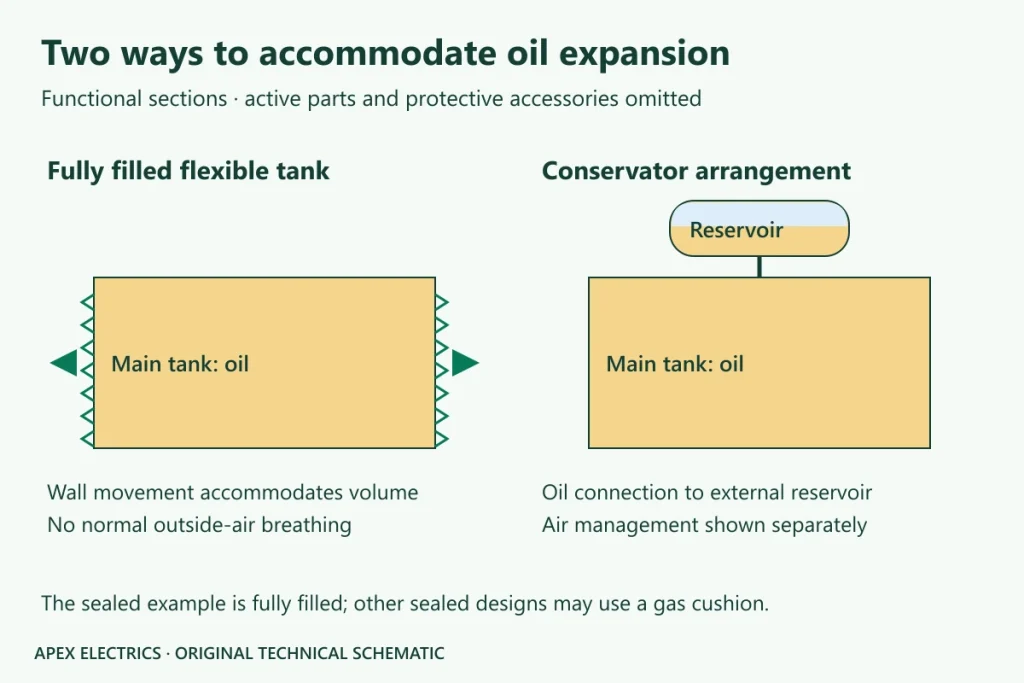
A hermetically sealed transformer limits normal exchange with outside air; a conservator-type transformer uses an external reservoir to accommodate oil-volume changes. The important buying question is not simply which tank looks better. It is how the proposed design handles thermal expansion, moisture control, protection and maintenance under the actual service conditions.
This article compares oil-preservation arrangements for procurement. It is not a filling, venting or commissioning procedure. The drawings below are original functional schematics, not photographs, manufacturing drawings or approved installation layouts.
How a fully filled corrugated sealed design handles expansion
Transformer oil expands as its temperature rises. In a fully filled hermetically sealed distribution transformer with a flexible corrugated tank, the engineered tank walls accommodate the volume change. There is no external conservator in this arrangement, and the oil is not intended to breathe ambient air during normal operation.
Not every sealed transformer uses that construction. Some designs use a gas cushion, and terminology varies between suppliers. Ask the bidder to identify the actual oil-preservation system, reference filling condition and permitted pressure or vacuum range. Corrugated cooling surfaces alone do not prove that a unit is fully filled and hermetically sealed.
INTRACO’s tank information distinguishes flexible corrugated walls for hermetic service from other corrugated tank constructions. Eaton’s liquid-immersed transformer manual also distinguishes fully filled sealed units, gas-cushion arrangements and expansion-tank equipment. These are design choices, not interchangeable filling instructions.
What a conservator does, and what a breather does
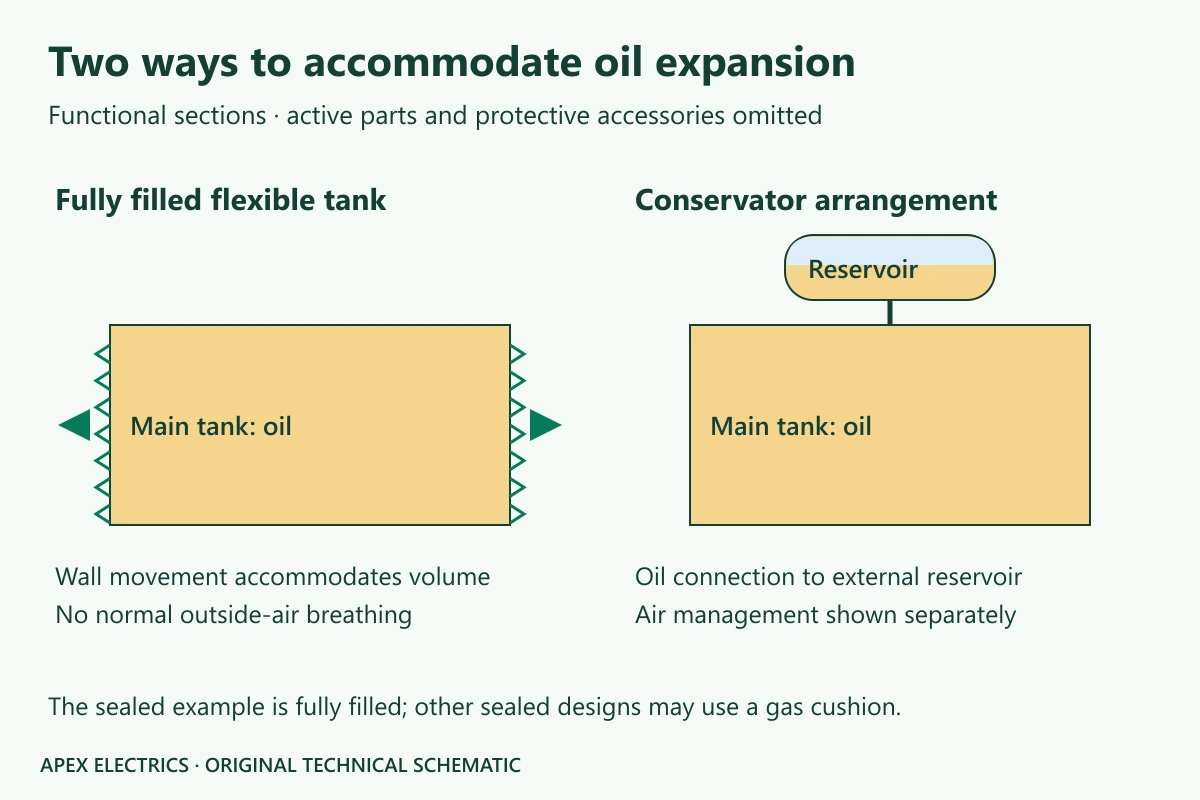
A conservator is a reservoir connected to the main tank by an oil pipe. As the oil expands or contracts, the reservoir accommodates the corresponding volume change. Its level indication must be interpreted against the design and oil temperature; a photograph cannot establish the correct filling level.
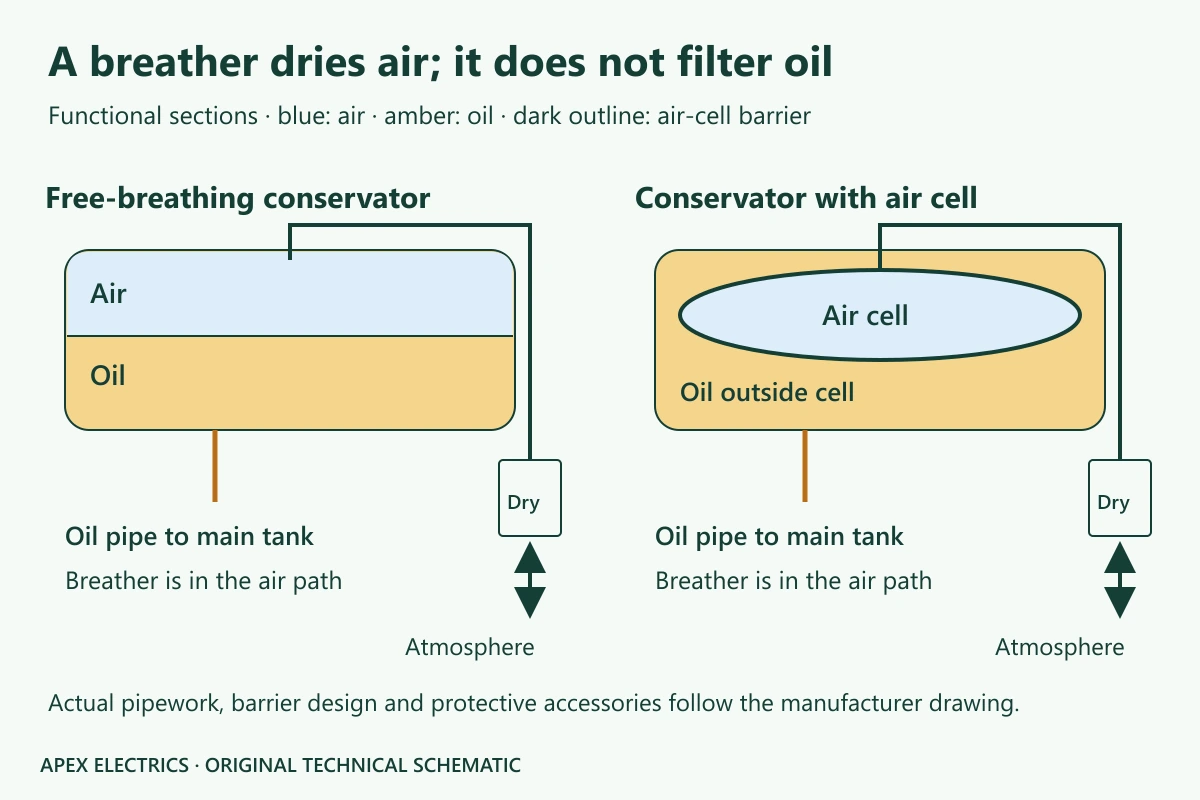
In a conventional free-breathing arrangement, an air space above the conservator oil communicates with atmosphere through the specified breathing path. A dehydrating breather dries incoming air; it is not an oil filter and does not make the transformer completely immune to moisture.
A bladder or diaphragm conservator adds a flexible separation between oil and the breathing air. For an air-cell arrangement, air passes inside the cell while oil remains outside it. The air path and the condition of that barrier still matter. Do not assume that every conservator includes a bladder, or that a breather can be omitted simply because a bladder is present.
Compare the maintenance tasks, not a “maintenance-free” label
A sealed arrangement can remove the routine breather-desiccant task associated with a conventional breathing system, but it does not remove inspections. Leaks, corrosion, bushings, connections, temperature indication, protective accessories and the manufacturer’s fluid-monitoring requirements still need attention.
A conservator arrangement adds reservoir, pipework, level indication and the specified air-management components to the inspection scope. Where a bladder is fitted, its integrity also matters. Regenerating and replaceable-desiccant breathers have different maintenance requirements; follow the particular device instructions rather than a generic colour-change rule.
Neither design should be opened, topped up, vented or subjected to vacuum using instructions borrowed from another transformer. Doing so can disturb the designed sealing, filling condition or pressure. Such work belongs to qualified personnel using the manufacturer’s procedure.
Which arrangement fits the project?
Remote distribution sites
Where routine access is difficult, compare the complete maintenance plan and available monitoring, not just the absence of a breather. Ask how leaks or abnormal pressure will be detected and what local support is available. A smaller accessory list does not establish a maintenance interval.
Humid, coastal or dusty locations
Oil preservation is only one part of environmental suitability. Also specify ambient temperature, altitude, corrosion exposure, terminal enclosure requirements and service access. A sealed main tank does not automatically provide a suitable corrosion system, bushing creepage distance or cable-box protection.
Utility or industrial substations
The owner’s standard may dictate a conservator, air cell, alarm contacts or particular inspection practices. Compare bids against that required configuration. Larger power-transformer projects need their own design review; the distribution example shown here is not a rule that assigns one preservation system to every MVA or voltage class.
Protection and cooling must be specified separately
Ask which pressure, gas, temperature and level devices are included, their alarm or trip functions and the information required for protection coordination. A conventional Buchholz relay is associated with the oil path between the main tank and conservator; it is not an accessory that can simply be fitted to any sealed unit without that arrangement. Other protective devices may be appropriate according to the design.
ONAN and ONAF describe cooling, not whether the transformer is sealed or conservator-equipped. Oil-preservation choice also does not by itself establish efficiency, short-circuit strength or expected life. Compare the guaranteed ratings, losses, tests and project duty separately. See our cooling guide and oil testing guide.
Questions to put in the enquiry
- Which preservation system is required: fully filled flexible sealed tank, sealed gas-cushion design, free-breathing conservator or conservator with a specified barrier?
- What are the electrical ratings, frequency, fluid specification and ambient/altitude conditions?
- Which pressure, gas, oil-level and temperature devices, contacts and drawings are included?
- What routine inspections, sampling procedures and service access does the manufacturer require?
- Are there utility approval, spill-containment, transport or installation constraints?
For relevant distribution duties, review our 11 kV and 20/24 kV oil-immersed transformer information. Voltage class does not replace the winding voltage, insulation and preservation requirements in the enquiry.
Discuss the oil-preservation arrangement with Apex. Start with your project location, voltage and required capacity; photographs, drawings and attachments are optional.
Technical references
- Eaton — liquid-immersed distribution transformer operation and maintenance manual.
- INTRACO / Convett — corrugated tank construction.
- SGB-SMIT — distribution transformer handling and maintenance instructions. Use only the instructions for the applicable construction.
- Aero Tec Laboratories — conservator air-cell operating principle.
- Reinhausen — dehydrating-breather function and regeneration. Device-specific features are not assumed for every breather.