
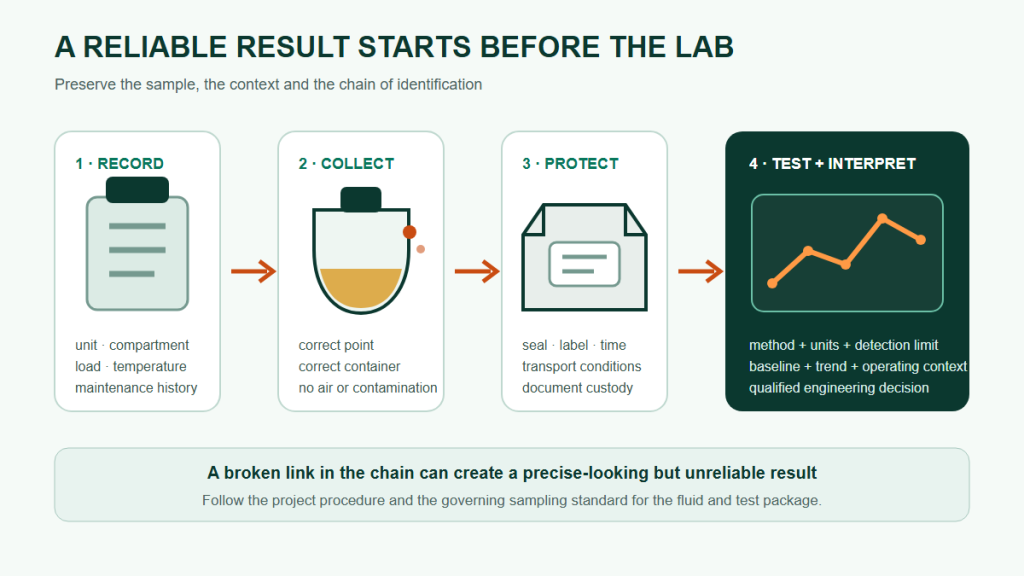
Transformer oil testing is not one pass-or-fail measurement. Dissolved gas analysis (DGA), moisture, breakdown voltage, acidity and dielectric-loss tests answer different questions. A reliable assessment starts with a representative sample, compares results with the correct fluid and equipment context, and gives more weight to repeatable trends than to one isolated number.
Why the test package must be defined before sampling
Mineral oil performs two main duties inside an oil-immersed transformer: it provides electrical insulation and transfers heat. It also carries evidence of what has happened inside the tank. Moisture, particles and ageing products affect the liquid itself, while gases dissolved in the liquid can provide evidence of thermal or electrical stress in the oil-paper system.
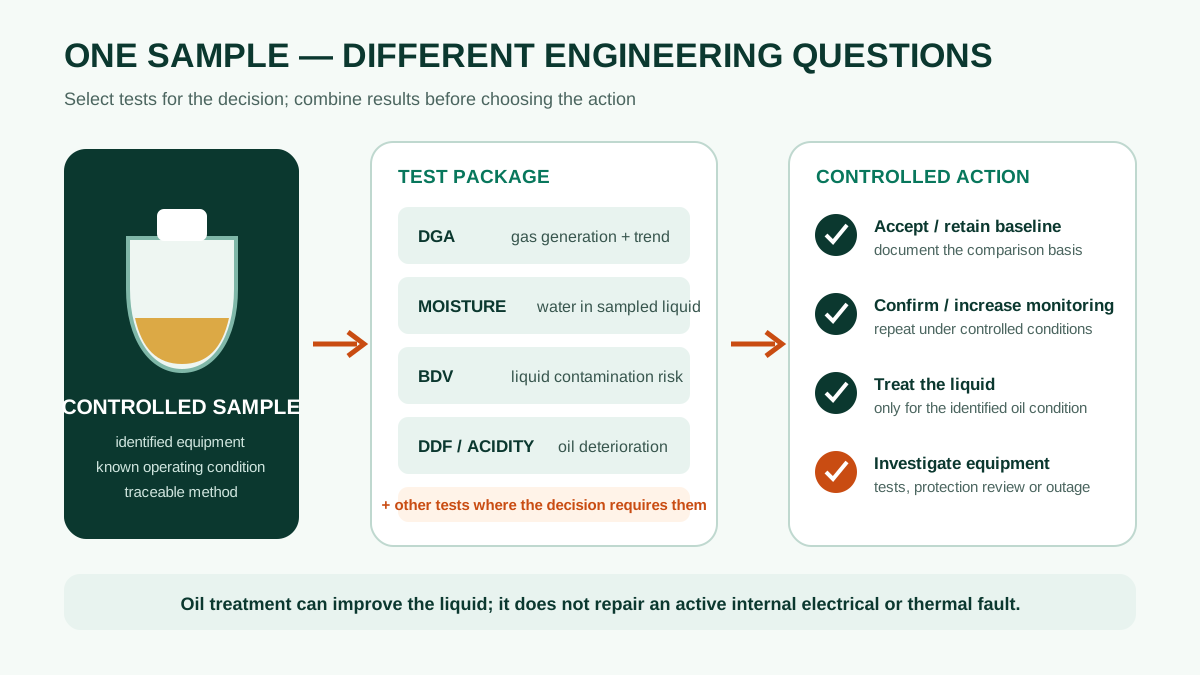
No single test covers all of these conditions. The requested laboratory package should therefore match the decision to be made: acceptance of new oil, a factory-test baseline, commissioning, routine condition monitoring, investigation after a protection operation, or assessment before extending service life.
Sampling quality comes before interpretation
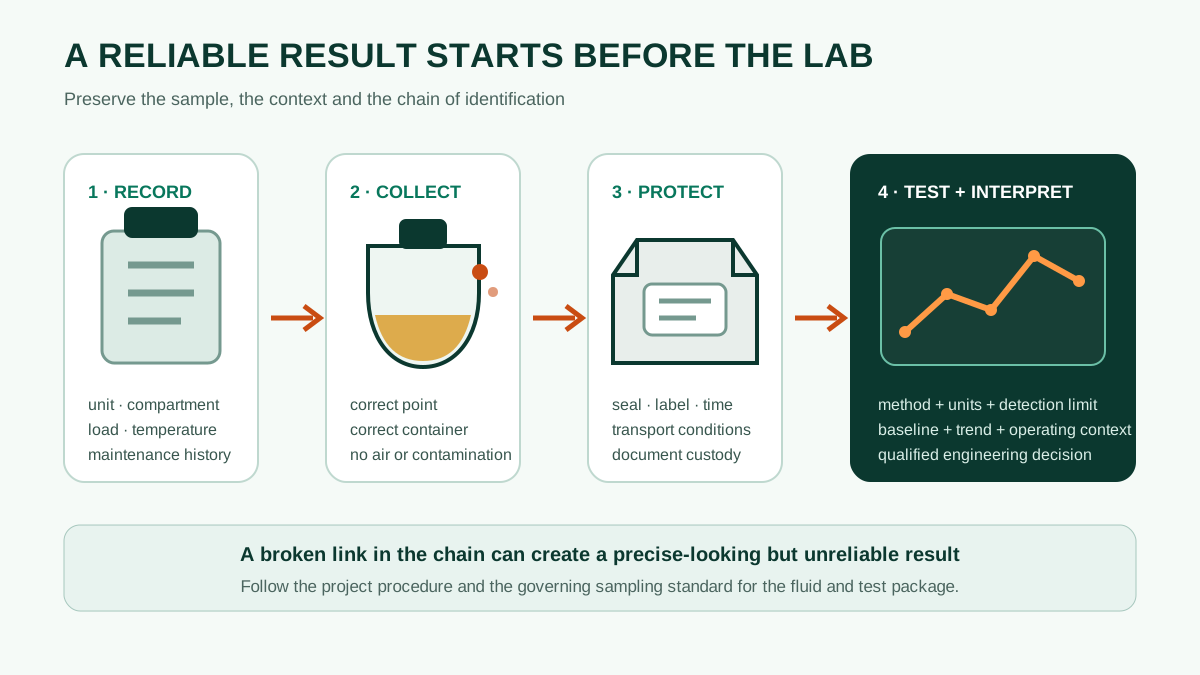
A non-representative or contaminated sample can produce a convincing but misleading report. Use the approved sampling point and the container specified for the intended analysis. Avoid introducing air, moisture, cleaning solvent, fibres or residues from previous samples. For DGA, the procedure must preserve dissolved gases during collection, transport and storage.
The field record should identify the transformer, compartment and sampling point; oil and ambient temperature; load and cooling condition; date and time; sampler; recent oil processing or maintenance; and any alarm, trip or abnormal observation. Main-tank and on-load tap-changer oil must not be treated as interchangeable samples because their normal operating environments and gassing behaviour are different.
- Use a controlled container: the container, closure and fill method must suit the specified laboratory test.
- Flush correctly: stagnant oil, water or dirt at the valve can distort the sample. Follow the approved procedure rather than applying an arbitrary volume.
- Prevent bubbles and leaks: headspace or a poor seal can change a DGA result.
- Label immediately: unit, compartment, point, time and condition must remain traceable to the report.
- Protect during transport: temperature, sunlight, vibration and delay can matter, depending on the test and container.
DGA: evidence of gas generation, not a diagnosis by itself
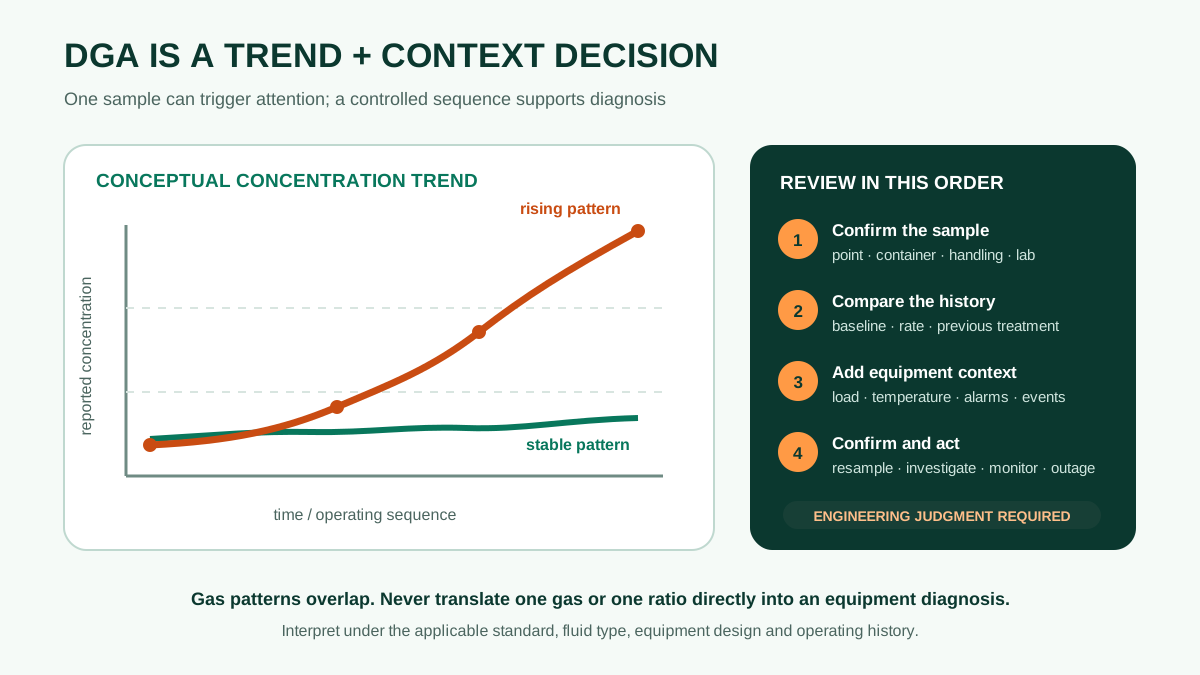
Electrical and thermal stress can decompose insulating liquid and cellulose, generating gases that dissolve in the oil. DGA measures selected gas concentrations and supports interpretation of the equipment condition. Hydrogen and hydrocarbon gases can be associated with electrical or thermal activity; carbon monoxide and carbon dioxide can provide information related to cellulose involvement. The pattern, concentration, rate of increase and operating context must be considered together.
A gas name should not be translated directly into a fault label. Different conditions can produce overlapping patterns, and the result can be influenced by oil type, previous oil processing, repairs, load history, sample handling and the transformer design. IEC 60599 explicitly treats interpretation as guidance requiring engineering judgment.
Moisture: separate oil water from paper water
Water moves between the liquid and solid insulation as temperature and operating conditions change. A moisture result expressed for the oil sample does not directly state the total moisture held in the winding paper. Oil type, temperature, ageing and equilibrium condition all affect interpretation.
For procurement and commissioning, control moisture through drying, vacuum filling, storage and exposure procedures, then establish a traceable baseline. For an in-service transformer, compare repeat samples taken under known conditions and combine the oil result with other diagnostic information when the moisture state of the solid insulation matters.
Breakdown voltage: a liquid-quality test with a defined scope
Power-frequency breakdown voltage (BDV) is measured in a specified test cell by increasing the applied AC field until breakdown occurs. It is useful for detecting contamination that reduces the electrical strength of the liquid, including water and suspended particles. The current IEC method is IEC 60156:2025.
BDV does not prove that the complete transformer insulation system is healthy, and it is not a substitute for DGA, moisture analysis, dielectric tests or transformer electrical tests. Electrode geometry, gap, stirring, sample preparation and test sequence must follow the selected standard; results from different methods should not be compared as though the procedures were identical.
Oil condition tests and what they tell the buyer
| Test or review | Main question answered | Important limitation |
|---|---|---|
| Dissolved gas analysis | Is gas being generated, and is the pattern or rate changing? | Requires context, repeatable sampling and engineering interpretation. |
| Moisture in liquid | How much water is measured in the sampled liquid? | Does not directly equal moisture in the cellulose insulation. |
| Breakdown voltage | How does the sampled liquid withstand a specified AC breakdown test? | Primarily indicates liquid contamination; it is not a complete transformer health test. |
| Acidity and ageing indicators | Is the liquid showing chemical deterioration? | Limits and action depend on fluid type, service condition and the governing guide. |
| Dielectric dissipation factor / resistivity | Are polar contaminants or conductive ageing products affecting dielectric behaviour? | Temperature and test method must be controlled. |
| Furan or other cellulose markers | Is there evidence associated with degradation of paper insulation? | Interpret with design, oil history, temperature and other condition data. |
Factory, commissioning and in-service results serve different purposes
A factory DGA programme may compare samples before and after a long-duration test such as temperature rise when DGA has been specified. A commissioning sample establishes the delivered baseline after transport, assembly, oil treatment and filling. In-service monitoring looks for changes against the established history and operating condition.
These stages should not be mixed without explanation. If oil was filtered, degassed, topped up or replaced, record the date, volume, fluid identification and processing method. Otherwise, the next report may appear to show an improvement or deterioration that is mainly the result of maintenance or dilution.
Use trends, confirmation and escalation rules
A useful oil-monitoring programme defines who reviews results, how quickly abnormal findings are confirmed, and what information triggers escalation. A sudden change after a trip deserves a different response from a slow and stable trend in an older unit. The response may include a repeat sample, laboratory confirmation, increased sampling frequency, online monitoring, transformer electrical tests, thermal inspection, protection review or an outage inspection.
Safety-critical decisions must remain with qualified asset and protection engineers. A website table or generic alarm limit cannot replace the governing utility procedure, equipment history and applicable standard.
Oil-test requirements to include in an RFQ
- Identify the fluid: mineral oil, natural ester, synthetic ester, silicone or another approved liquid, including the governing specification.
- Define the stage: new-liquid acceptance, factory baseline, before/after specified tests, shipment, site filling, commissioning or service monitoring.
- Name the methods: state the applicable IEC, ASTM or project method for sampling and each laboratory test.
- State the sampling points: main tank, tap changer or other compartment, with suitable valves and safe access.
- Require traceability: sample identification, date, equipment condition, laboratory method, units, detection limits and authorized report.
- Define comparison and action: identify the reference baseline, acceptance basis, resampling rule and party responsible for engineering interpretation.
Practical conclusion: an oil report should support a controlled engineering decision, not produce a diagnosis from one highlighted number. Specify the sample method, test purpose and comparison basis before the sample is taken, then retain every result with the transformer’s maintenance and operating history.
Technical references
- IEC 60475:2022 — Method of sampling insulating liquids
- IEC 60567:2023 — Sampling and analysis of free and dissolved gases
- IEC 60599:2022 — Interpretation of dissolved and free gases
- IEC 60422:2024 — Supervision and maintenance of mineral insulating oils
- IEC 60156:2025 — Power-frequency breakdown voltage test method