
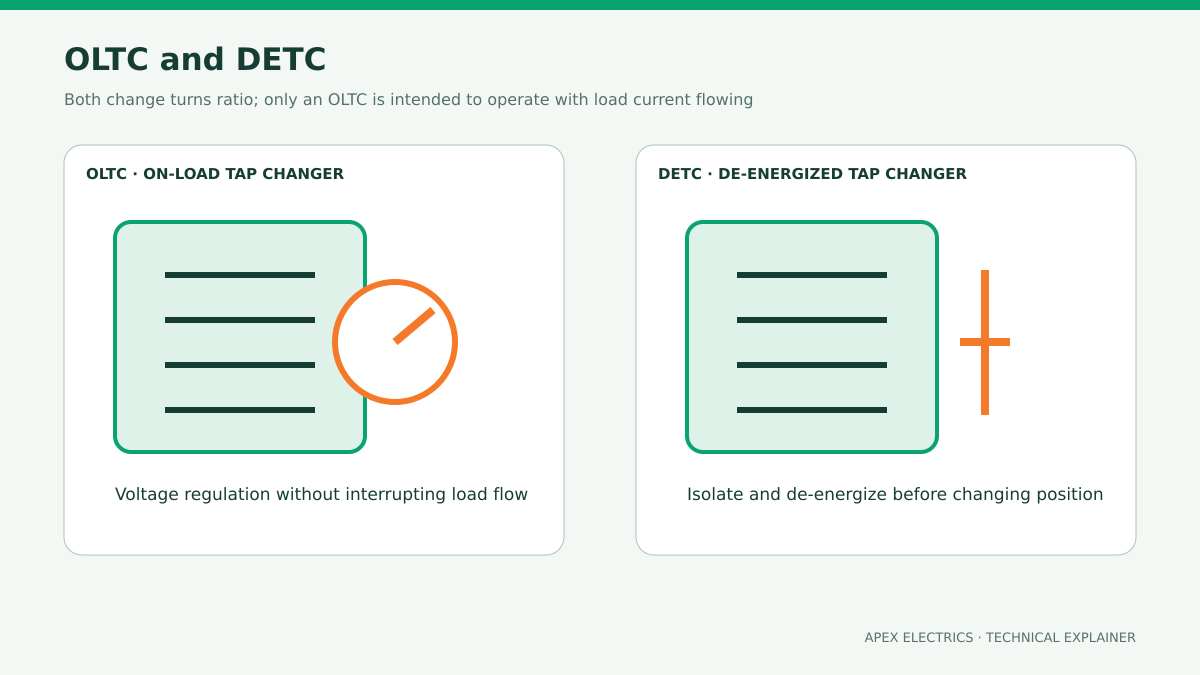
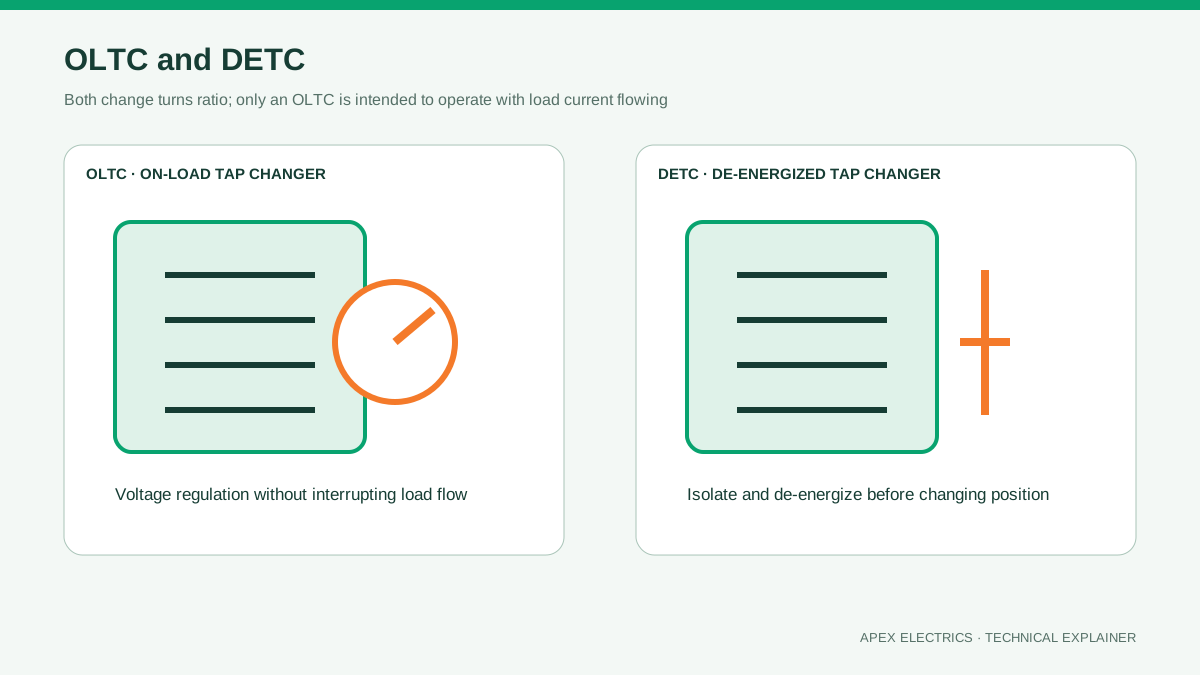
An on-load tap changer (OLTC) changes transformer ratio while the transformer carries load. A de-energized tap changer (DETC, also called an off-circuit tap changer) may be operated only after the transformer is de-energized and safely isolated. The choice affects voltage regulation, transformer cost, control equipment and maintenance.
OLTC and DETC compared
| Decision point | OLTC | DETC |
|---|---|---|
| Operation | With the transformer energized and carrying load | Only when de-energized and safely isolated |
| Typical purpose | Automatic or commanded voltage regulation | Commissioning adjustment or infrequent ratio correction |
| Main equipment | Diverter/selector arrangement, transition impedance, drive and controls | Simpler tap selector and operating mechanism |
| Maintenance | More components and operating-duty records to manage | Lower mechanical duty, but position and contacts still require inspection |
| Commercial effect | Higher initial and lifecycle complexity | Lower complexity where continuous regulation is unnecessary |
Why an OLTC needs a transition circuit
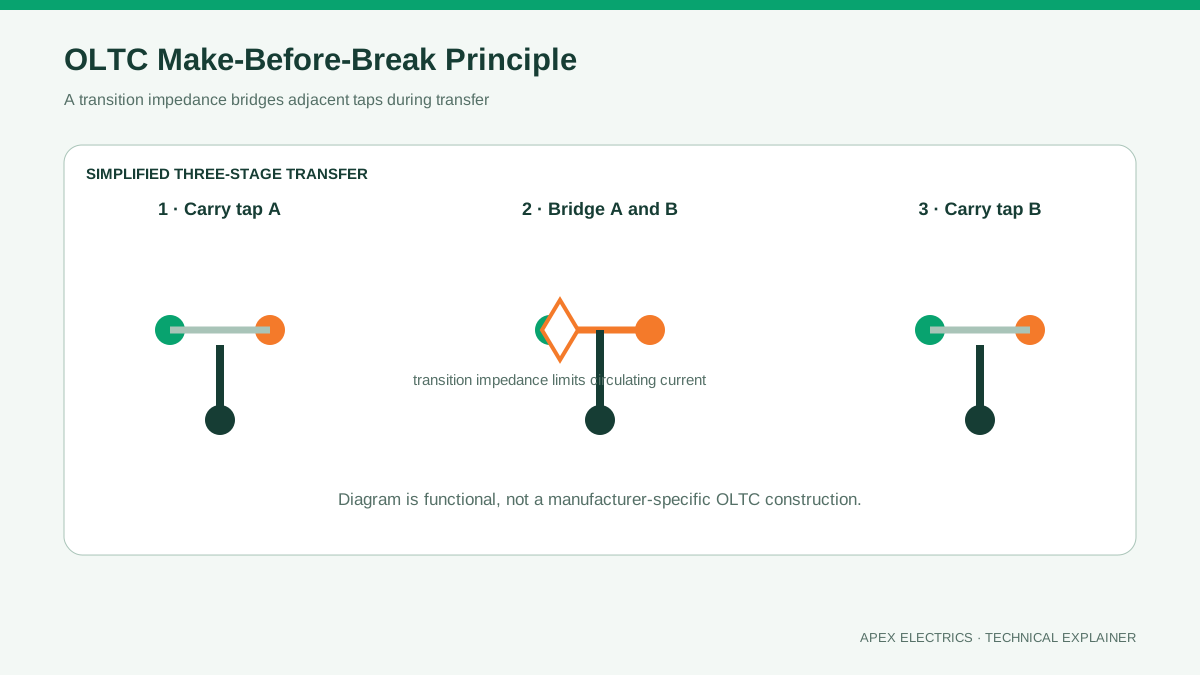
During a tap change, load current must continue while the connection moves from one tap to the next. The switching sequence therefore uses a make-before-break principle with transition resistance or reactance to prevent an open circuit and limit circulating current between adjacent taps. This is a controlled switching operation, not a simple selector movement.
Data needed to specify the tap range
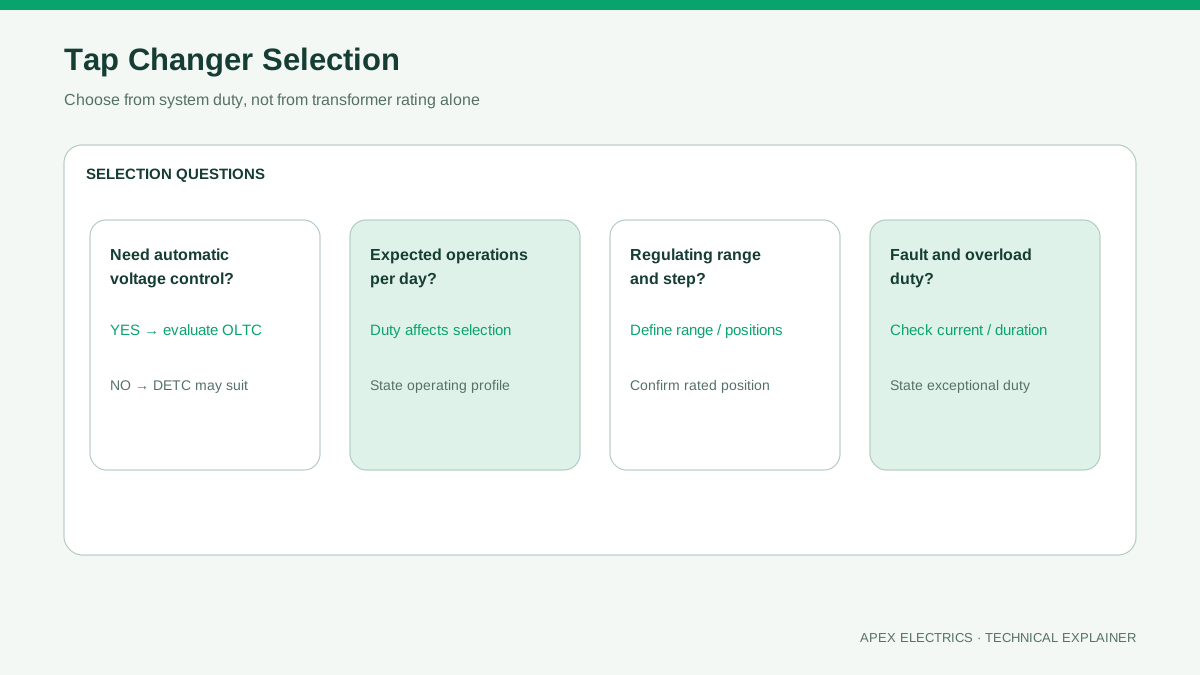
A statement such as “OLTC ±10%” is incomplete. The supplier also needs the regulating winding location, number and size of tap steps, normal tap position, constant-flux or variable-flux requirement, maximum through-current, insulation level, short-circuit duty and the control philosophy. The system study should show the voltage range that the transformer must correct under realistic load and source conditions.
- Nominal HV and LV voltages and allowable bus-voltage range
- Total regulating range, step percentage and number of operating positions
- Manual, remote or automatic voltage control requirements
- Line-drop compensation, paralleling and master-follower requirements
- Expected operations per day and maintenance constraints
- Alarm, blocking and protective-device interfaces
When a DETC is the better choice
A DETC is often sufficient where the source voltage is stable, the transformer is not expected to regulate a live bus, and planned outages are available for occasional adjustment. It can avoid unnecessary equipment and maintenance. However, operators must never treat a DETC as an OLTC: the transformer must be de-energized, isolated, proved dead and handled under the site’s safety procedure before its position is changed.
Procurement checks before approval
Confirm the tap table on the nameplate drawing, the voltage associated with each position, the normal position, the direction of voltage change and the motor-drive supply. For an OLTC, also review its type-test evidence, protective device, monitoring contacts, control cabinet, operation counter and maintenance instructions under the applicable IEC 60214 requirements.
Practical conclusion: Do not pay for an OLTC simply because a transformer is large. Select it when the network study demonstrates a need for live voltage regulation and define the complete operating duty in the enquiry.